
We’ve all seen the productivity gurus preaching about The Power of Consistency. Usually, the goal is simple: do one thing every day for a month and watch the magic happen. This applies to anything; hitting the gym, writing 1,000 words, or posting a Reel every day. The 30-day challenge is a staple of self-improvement.
In 2020, I decided to take this concept and point it directly at my personal brand. I set out with an aggressive, data-driven hypothesis: Could a single person reach 1 million listeners in just 30 days using nothing but "Other People’s Microphones" (OPM)?
I called it the 30 Interviews in 30 Days challenge. My goal was to prove that you don’t need a massive PR firm, a dedicated booking agent, or a £10,000 monthly ad spend to achieve rapid brand growth. You just need a repeatable and scalable system.
Looking back at that experiment from the vantage point of 2026, the results are more relevant than ever. In an era where AI-generated content has flooded every social feed and inbox, the real human signifier of a podcast guest appearance has become the experts and aspiring thought leaders number one asset. Podcasting is one of the few mediums where you can hold a captive audience's attention for 30 to 45 minutes straight.
The result of my experiment? I failed. But not because I fell short of the mark. I "failed" because I overshot the target so significantly that the experiment broke my schedule, tested my mental bandwidth, and ultimately proved that the Guest Academy methodology is even more powerful than I had originally imagined.
The Hypothesis: Why Podcast Guesting is the Ultimate Growth Hack
Before we get into the "failure," we have to look at why I chose this specific medium. In 2020, the digital landscape was getting crowded (for obvious reasons), but podcasting was entering its golden age. Fast forward to 2026, and while the platforms have evolved, the underlying psychology remains the same.
When you appear as a guest on someone else's show, you aren't just marketing yourself. You are:
- Borrowing Authority: The host has spent years building trust with their audience. When they introduce you, that trust is instantly transferred to you.
- Tapping into "Found" Time: Unlike blog posts or videos that require active attention, podcasts are consumed during "dead time", ie. commuting, gym sessions, or doing the dishes. This leads to higher completion rates.
- Creating SEO Moats: Every show you appear on creates a high-authority backlink and a permanent digital footprint that search engines crave.
My theory was that if I could condense a year’s worth of networking into 30 days, the sheer density of the exposure would create a tipping point for my brand. I wasn't looking for a slow burn; I wanted an explosion.
The "Failure": When the System Works Too Well
The plan was simple: book one interview per day. I assumed that even with a high-performance outreach strategy, there would be a natural drop-off rate. I expected some hosts to reschedule, some to ghost, and some to simply say no.
However, because the outreach system was so dialed-in, the "Yes" responses didn't just meet the quota—they obliterated it.
By the end of the 30-day sprint, I hadn't done the original 30 interviews. I had booked 46.
This is where the "failure" happened. I reached a logistical burnout point. My calendar was no longer a tool; it was a cage. I was frequently performing three interviews a day, often across different time zones. I’d finish a session with a host in London at 10:00 AM, jump on a call with a New York-based tech show at 2:00 PM, and wrap up with a Sydney-based entrepreneur at 9:00 PM.
I had to pivot my entire business operation mid-month just to keep up with the volume. My "failure" was a failure of capacity, not a failure of strategy. It was a chaotic, high-energy lesson in what happens when your content marketing experiment scales faster than your personal bandwidth.
But the data that came out of that chaos made it all worth it.
System Over Stress: The Three Pillars of Scale
You cannot book 46 interviews in a month by sending hopeful emails. If you try to do this manually, you will spend eight hours a day in your inbox and zero hours behind the microphone. To handle this kind of high-volume podcast guesting, I relied on the three pillars we now preach at the Guest Academy.
1. The High-Value One-Sheet
Most guest pitches fail because they focus on the guest’s ego. They list awards, accolades, and "buy my book" links. My one-sheet was different. It was designed as a Show-in-a-Box format.
- Clear Value Propositions: I offered three distinct episode themes that I could deliver.
- Technical Readiness: I listed my kit (high-quality mic, lighting, and hardwired internet) to reassure hosts that the audio wouldn't be a nightmare to edit.
- Proven Social Proof: Links to previous appearances to show I knew how to tell a story.
2. The Matchmaker.fm Magic
Finding 46 relevant shows manually is an impossible task. I used Matchmaker.fm to filter for my specific niche. Instead of chasing the Top 1% shows where the gatekeepers are impenetrable, I focused on high-engagement, mid-tier shows.
- Relevance over Reach: A show with 500 dedicated listeners in your exact niche is worth more than a show with 50,000 listeners who don't care about your industry.
- Community Engagement: I targeted hosts who were active on LinkedIn and Twitter, ensuring the interview would have a second life on social media.
3. The Scalable Outreach Template
The secret to my 46-interview sprint was a framework that felt personal but was built for speed.
- The Hook: Mentioning a specific recent episode of theirs so they knew I wasn't a bot.
- The Bridge: Briefly explaining why my expertise solved a problem their audience currently has.
- The Easy Exit: Making it incredibly easy for them to say "no" or "not now," which paradoxically makes people more likely to say "yes."

The Multiplier Effect: Why 1 Interview = 3 Leads
One of the most profound takeaways from this experiment was the Multiplier Effect. Many people think of podcast guesting as a linear activity: you do one show, you get one set of listeners.
In reality, it is exponential. I noticed a recurring pattern: for every high-quality appearance I made on a reputable show, I would receive two or three inbound invitations from other hosts who had heard the segment.
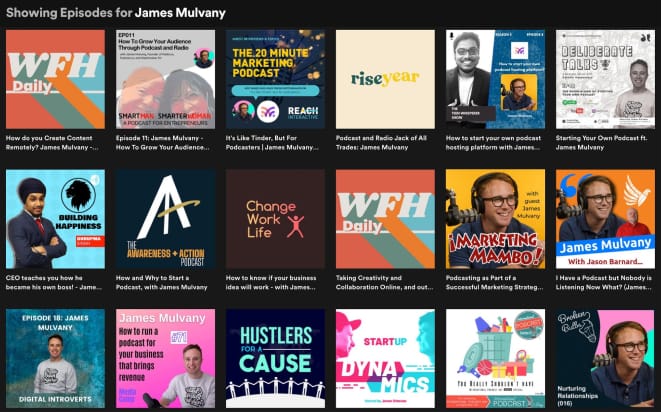
- Inbound Momentum: After my appearance on 12 Hats Radio, I had three other hosts reach out within 48 hours.
- Social Validation: Hosts talk to each other. When you are a good guest (meaning you provide value, stay on time, and promote the episode), word gets around.
- The Omnipresence Illusion: By appearing on 46 shows in a month, I created the illusion that I was everywhere. Potential clients and partners couldn't open their podcast app or LinkedIn feed without seeing my name. This is the rapid brand growth strategy in its purest form.
The Results: Breaking Down the ROI
Even in 2026, the long-tail benefits of that 2020 sprint are still being felt. Here is a breakdown of what that month of "failure" actually produced:
- Total Interviews Booked: 46 (Crushing the original goal by 53%).
- Estimated Combined Listenership: Over 1.2 million unique ears.
- Inbound Lead Generation: A 40% increase in sign-ups for Matchmaker.fm and Podcast.co during that quarter.
- SEO Dominance: Dozens of high-DA (Domain Authority) backlinks that pushed my personal site and business sites to the top of Google for key industry terms.
- Content Library: We extracted over 200 micro-content clips from these interviews. These were used for TikToks, YouTube Shorts, and LinkedIn posts, fuelling our social media strategy for nearly six months without me having to produce new content.
Why This Strategy is Still the Gold Standard in 2026
You might be wondering: "James, that was 2020. Does this still work in 2026?"
The answer is yes, and arguably, it works better now. The podcasting for reach landscape has matured. While there are more podcasts than ever, the quality gap has widened. Professional hosts are desperate for guests that are more than experts. They are looking for performers. People who can articulate a vision, provide a unique take, and help the host grow their own show.
When search results are being replaced by AI answers, being the source of the information is the only way to stay relevant. When an AI summarises a topic, it looks for the most cited, most heard, and most authoritative voices. By guesting on 46 shows, you are reaching people, feeding the algorithms, and helping them decide who the "authority" is.
Want the exact blueprint? Get the Podcast Guest Academy templates and start booking high-authority interviews today.
Lessons Learned: How to Avoid My "Failure"
If you are planning your own sprint, here is how you can achieve the results without the burnout:
- Batch Your Recordings: Instead of doing 1–3 interviews every day, try to consolidate them into "Recording Days" (e.g., Tuesdays and Thursdays). This protects your deep-work time.
- Standardise Your Tech: Have a "Plug and Play" setup. If it takes you 20 minutes to set up your mic and camera, you will fail. It should be one switch and you're ready to go.
- Invest in a Follow-Up System: The real ROI isn't in the interview; it's in what happens after. Having a system to thank the host, share the assets, and keep in touch is what turns a guest spot into a long-term partnership.
Conclusion: Stop Guessing, Start Guesting
The 30 Interviews in 30 Days challenge proved that the biggest obstacle to your brand's growth isn't a lack of audience, it’s a lack of a proven outreach strategy.
I "failed" the challenge because I didn't realise how hungry the podcasting world is for high-value guests. There are millions of microphones out there waiting for a voice like yours.
The exact templates, booking workflows, and outreach strategies I used during this 46-interview sprint are the foundation of what we teach at the Guest Academy. We’ve refined the process so you can get the massive reach and lead flow I experienced, without the total calendar meltdown I endured.
Join the Guest Academy today and build your own outreach super strategy.